
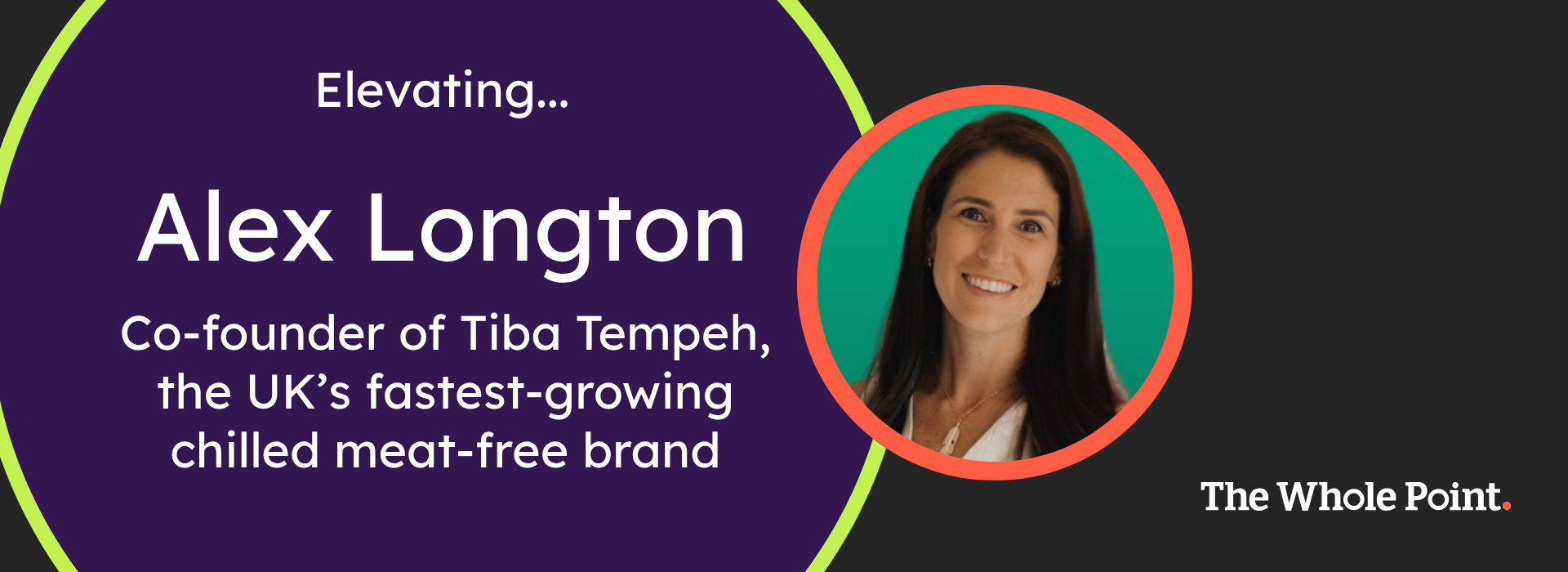
Welcome to the Elevate Series from the Newcastle Regional Board of The Whole Point. This instalment features Alex Longton, Co-founder of Tiba Tempeh — officially the UK’s fastest-growing meat-free brand at the time of writing.
Alex’s story is a great example of spotting an opportunity, loving what you do, and knowing how to commercialise it. Bootstrapping a business is tough work, but Tiba Tempeh’s success is a testament to Alex’s drive and determination. We spoke to Alex about the challenges of fundraising, the power of hindsight, and how to push forward when there’s no blueprint to follow. Hope you enjoy!
Tell us about your background and journey so far
I’m the Co-founder of Tiba Tempeh, and my background is very much rooted in the food industry. I spent around 15 years working for large food brands, including Kraft Heinz, Lindt and Plenish, where I built up deep experience and a real passion for food and innovation.
About ten years ago, I became increasingly interested in the plant-based movement. While on holiday in Bali, my husband and I discovered tempeh and immediately felt it was something special. It had everything we were looking for nutritionally and in terms of taste and texture, yet it barely existed in the UK market at the time. That moment sparked the idea for Tiba Tempeh, and from there, our journey began.
Tell us about your business
Tempeh is often compared to tofu, but it’s made from whole fermented beans rather than soy milk, which means it has more protein, more fibre and far more texture. It’s a naturally nutritious, plant-based protein.
We launched Tiba Tempeh six years ago, and today we’re proud to be the leading tempeh brand in the UK. Our products are stocked in major retailers including Sainsbury’s, Waitrose, Morrisons and Ocado, among others. What’s particularly exciting is that we’re currently the fastest-growing brand in our category, outperforming some much larger and more established names.
Tell us about your fundraising journey so far
In the early days, we made the decision to bootstrap the business. For the first two years, I was the only person working full-time in the company, while my husband continued in his job to help balance the financial risk. We funded everything through our own savings, paid ourselves no salaries, and ran the business as leanly as possible.
Looking back, it was a tough but formative period. Bootstrapping forced us to build resilience, credibility, and discipline, and it gave us confidence that the business really worked. When we did decide to raise investment, we skipped angel funding and went straight to a venture capital investor who truly understood the plant-based space and could add strategic value as well as capital.
That first investment helped us scale quickly and secure listings with major retailers. Since then, we’ve completed two further raises, bringing on a small number of highly strategic investors with complementary expertise.
What challenges have you experienced in obtaining funding?
The most challenging part was the very beginning. Bootstrapping put a lot of pressure on us financially, and the first fundraising round felt daunting because we had never done it before. Going through due diligence, negotiating valuation, and signing shareholder agreements all felt quite overwhelming at the time.
You can have a great business, but without experience of fundraising, it’s hard to know whether you’re making the right decisions or signing up to the right terms. In hindsight, I would probably have raised earlier, but learning how to fundraise isn’t straightforward and there’s no clear handbook for it.
One of our biggest learnings was dividing responsibilities. I focused on running the business day-to-day, while my co-founder focused on fundraising. The business can’t stop while you’re raising money and having that separation made a huge difference.
Tell us about the best nonfinancial support or piece of advice you have been given
One piece of advice that really stayed with me was that it’s better to own a smaller piece of a much bigger pie than 100% of a small one. It sounds cliché, but it helped shift our mindset. Bringing the right investors on board isn’t just about funding; it’s about surrounding yourself with people who can help you grow and scale sustainably.
On a practical level, we also received fantastic support locally. Organisations such as UMI and RTC North played a key role in offering guidance, connections, and introductions to investors, particularly in the North East ecosystem.
What’s the thing that you are most excited about in the future for your business?
We’re already the fastest-growing brand in the meat-free category, despite only having around 50% distribution across the UK. That means there’s still an enormous opportunity ahead of us.
In the short term, I’m excited about expanding into more supermarkets and increasing our presence on shelves nationwide. Longer term, our ambition is to become the number one tempeh brand not just in the UK or Europe, but globally. We genuinely believe that’s achievable.
What’s one piece of advice you’d have for an entrepreneur just starting out?
My advice would be to bring together three things: your passion, your experience, and a genuine market opportunity. When those three overlap, that’s where the magic happens.
You need to love what you’re doing, understand the industry you’re working in, and be solving a real problem that people are willing to pay for. Once you have that, start somewhere, start now, and figure it out as you go. There are far more people out there willing to help than you might expect.
How would you change the ecosystem to help women get the funding that they need?
I think investors need to broaden their mindset and recognise that women-led businesses may have different styles, priorities, and growth approaches, often focused on long-term, sustainable success rather than short-term hypergrowth.
Funding processes and pitching norms have traditionally been shaped around male-dominated models, and that can disadvantage women founders. A shift in how investors assess opportunities, value leadership styles, and welcome different approaches would make a real difference.
Who have been your role models?
My first role models have always been my parents. My dad ran his own business, and my mum balanced a career in teaching while raising a family. They shaped my work ethic and resilience.
Professionally, one of my biggest role models is Kara Rosen, the founder of Plenish. She built an incredible plant-based business from scratch and went on to successfully exit it. Working alongside her and seeing a woman lead, scale and sell a business had a lasting impact on me. Even now, I often find myself thinking, “What would Kara do in this situation?”
And finally, who would you like to elevate?
I’d love to elevate Abi Reid, cofounder of Merwave, a North East-based business that has achieved impressive growth and recently launched into Boots. She’s built a successful brand in retail, which is a space I’m deeply passionate about, and she’s a brilliant example of what female founders in the region can achieve.