
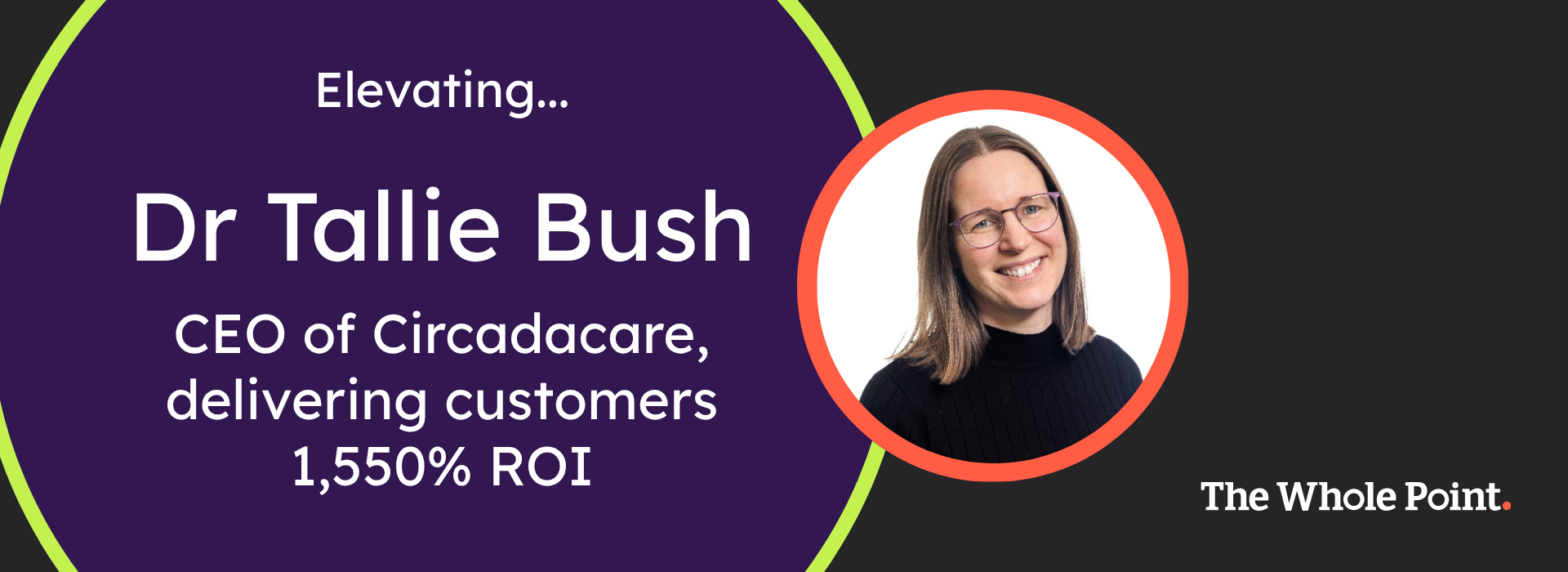
(CEO of Circadacare, delivering customers 1,550% ROI)
Welcome back to the Elevate Series from the Newcastle Regional Board of The Whole Point. This issue features Dr Tallie Bush, CEO of Circadacare, a “tech for good” company doing wonderful work up here in the North East.
Tallie told us about her journey from academia to entrepreneurship, how to approach funding when your burn rate is high, and how to avoid burnout yourself!
Tallie also shares some insights around the “male-dominated norms” of fundraising and what a more women-led ecosystem could look like.
Tell us about your background and journey so far
Before moving into entrepreneurship, my background was in academia. I spent many years as a neuroscientist, most recently as a computational neuroscientist, working primarily in frontotemporal dementia, with some work in sleep and epilepsy. Importantly, my work wasn’t just data-driven; I spent a lot of time with people living with dementia and with their carers.
What became very clear was how limited the support structures were for families navigating diagnosis, care pathways, and day-to-day challenges. I was approached by one of the founders to help build a product that could genuinely improve people’s lives, and I could immediately see the potential impact.
I initially came in to help build the technology, but over time, I became a co-founder and CEO. I’ve spent the last four years growing the business — first building the product myself and then assembling the right technical and commercial teams to take it to market.
Tell us about your business
Our business focuses on circadian lighting technology designed to support people living with dementia, frailty, or age-related challenges, as well as their carers. Circadian rhythm is our natural physiological cycle that responds to light and darkness, and it plays a critical role in sleep, mood, alertness, and overall wellbeing.
As we age, less light reaches the back of the eye, and the receptors responsible for regulating circadian rhythm deteriorate. This can lead to sleep disruption, confusion, agitation, and increased risk of falls — particularly for people with dementia. Our solution provides indoor lighting that supports circadian rhythms, while incorporating sensors that monitor the environment and activity patterns.
The technology is deliberately designed to be unobtrusive. It sits within standard light fittings, with no wearables, buttons, or visible technology, which significantly improves acceptance. Alongside the lighting, the data supports carers with care planning and helps reduce stress, wandering behaviours, and risks such as falls.
One buyer’s return on investment analysis showed savings of £16.50 for every £1 spent, demonstrating both social impact and system-level value.
Tell us about your fundraising journey so far
My entry into the business came after the company had already secured initial funding, including venture capital investment and Innovate UK grant funding. That meant I was able to join with a salary in place, which reduced personal financial risk and made the transition into entrepreneurship more accessible.
Since then, the business has continued to raise funding through a combination of grants and private investment.
This is a deeptech, “tech for good” business based in the North East, and it comes with a high burn rate due to product development, hardware, and regulatory complexity.
Grant funding enabled us to reach our minimum viable product, but it quickly became clear that further investment was essential to differentiate our solution and scale sustainably.
What challenges have you experienced in obtaining funding?
One of the biggest challenges is that no one teaches you how to fundraise.
There’s a lot of emphasis on perfecting pitch decks, but far less guidance on everything else: understanding valuation, term sheets, loan notes, when to seek professional advice, and how to ensure you’re not agreeing to terms you don’t fully understand.
Even now, I’m still learning.
I wasn’t involved in the first raise, but I’m now heavily involved in executing subsequent rounds, and it’s an intense and sometimes intimidating process. You largely learn by doing, hoping you come out the other side well enough equipped to do it again.
Tell us about the best nonfinancial support or piece of advice you’ve been given
The most meaningful advice I’ve received has been around burnout and sustainability.
At one particularly stressful point, I was advised not to chase every opportunity, not to feel that I had to say yes to everything, and to recognise when it was time to rest rather than push.
Entrepreneurship often comes with the narrative that you have to be everywhere, meet everyone, and pursue every possible lead. But there’s also value in stepping back, choosing the right opportunities, and giving them your full attention.
I’ll be honest, I don’t always manage to follow this advice. But it’s stayed with me and remains incredibly important.
What’s the thing that you’re most excited about in the future for your business?
I’m most excited about becoming a trusted thought leader in this space. Beyond scaling the product, it’s about being recognised as a credible, evidence-based voice that people can rely on.
I want our business to help shape thinking, influence best practice, and build trust with carers, providers, and decision-makers. Knowing that what we do works and that it genuinely improves lives is what excites me most about the future.
What’s one piece of advice you’d have for an entrepreneur just starting out?
Talk to people — early, often, and honestly. Passion and conviction are essential, but you also need to understand whether you’re truly solving a problem that people can and will pay for.
Engage with the people you believe will buy your product or service and listen carefully to what they tell you.
If they can’t pay, don’t have the mechanism to pay, or don’t see the value, you need to understand why before moving forward. Passion alone isn’t enough; you have to be answering a real, fundable challenge.
How would you change the ecosystem to help women get the funding that they need?
Much of the investment world still operates through male-dominated norms and communication styles. Being the only woman in the room can leave you constantly second-guessing how to present yourself, what’s expected, and whether you’re being assessed fairly.
When women are in female-led environments, the difference in interaction, idea-sharing, and discussion is striking.
We know that women-led businesses deliver strong, stable returns, yet funding still doesn’t reflect that reality.
Changing the ecosystem means recognising different leadership styles, valuing long-term impact, and creating funding spaces where women don’t feel perpetually on the back foot.