
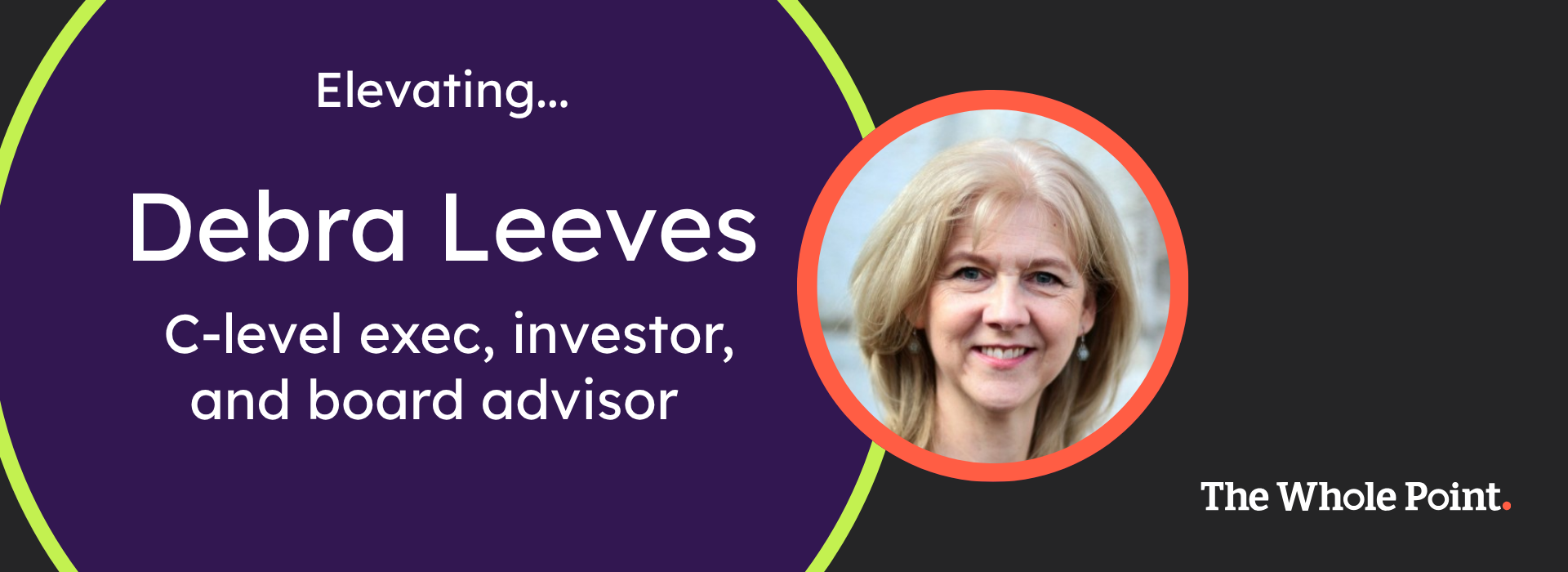
C-level exec, investor, and board advisor
Welcome to the Elevate Series, brought to you by the Newcastle Regional Board of The Whole Point. In this instalment, we hear from Debra Leeves, C-level executive, investor, and board advisor about navigating the highs and lows of the fundraising journey.
With 35+ years in the sector and experience on both sides of the investment table, Debra offers practical insights for founders looking to scale.
From demystifying funding routes to sharing what really makes a business investable, her perspective is invaluable.
Tell us about your background and journey so far
I’ve worked in biotechnology for over 35 years, and today I wear many hats.
I chair several companies across the UK — primarily healthcare and manufacturing businesses at various growth stages, from startups to well-established firms. I chair the Remuneration Committee and Spectrum X in Manchester, and I’m a Board Governor at the University of Sunderland. I’m also a shareholder in several companies across the North East and an investor in sectors I understand, including healthcare, biotechnology, and technology (along with a few riskier outliers).
Having been on both sides of the fundraising table, I understand the challenges involved, and I’ve found it incredibly valuable to help women navigate the process and understand where money can be raised from.
I believe it’s important for women to recognise that there are multiple funding routes available, and they don’t need to be tied to just one.
Tell us about your fundraising journey so far
I began fundraising around 20 years ago. My first experience was raising £10.3 million for a New Zealand-headquartered company, which led to an IPO. I found the process fascinating and gained valuable insights.
Since then, I’ve continued raising funds for my own ventures, with an average ticket of £1-2 million, as well as for companies I mentor.
Most of my funding efforts have been in the South East, and I’ve found it easier to raise funds there compared to the North East.
What challenges have you experienced in obtaining funding?
I’ve found fundraising in the North East more challenging due to longer timelines, fewer angel investors, and a less developed VC network. Compared to the South East, with its stronger university links and more established funding infrastructure, fundraising here requires more effort — especially for female founders.
Although progress is being made, the region still lags.
My advice is: start early and prepare for your next round as soon as you close the last.
Tell us about the best non-financial support or piece of advice you have been given
I’ve received several pieces of valuable non-financial advice over the years. One key takeaway is the importance of having a clear and correct commercial strategy. You need to ensure there’s a market for your product and a solid plan to get it there.
In industries like healthcare, changing established practices takes time, so you need to consider whether your product complements existing solutions or could be sold or licensed to larger companies.
Competing globally as a small startup can be unrealistic without significant resources, and founders can be reluctant to sell because of emotional attachment, but outside advisors can give you a more balanced view.
I’d also stress the importance of being realistic about cash flow and funding timelines.
What’s the thing you’re most excited about for the future of your work?
I’m most excited about the transformative potential of AI in both technology and healthcare.
I believe AI can help diagnose diseases earlier, which can lead to better outcomes and potentially reduce healthcare costs. Early detection, especially for conditions like Alzheimer’s, could allow for new drugs to slow disease progression. With more grant programs favouring AI-driven projects, there are increasing opportunities to secure funding for these initiatives.
AI gives real hope for conditions like Alzheimer’s, where past clinical trials have failed, because it can predict who is in the early stages and enable early intervention. The potential for AI to save lives and improve global health is what really excites and motivates me for the future.
What’s one piece of advice you’d have for an entrepreneur just starting out?
Take advice early — you don’t need to be an expert in everything.
If you’re unsure, tap into your network or speak to someone who’s done it before.
Get support in the areas that aren’t your strengths. Many mentors are happy to help, and their insights can save you time, stress, and costly mistakes. Founders often burn out trying to do it all, but asking for help is a strength, not a weakness, and it can make a real difference.
How would you change the ecosystem to help women get the funding that they need?
I’ve noticed on the boards I’ve been part of that, when there’s more diversification of thought, it leads to better business decisions. Boards that are more diverse across ethnicity, age, background, and gender are less prone to groupthink.
That’s why I believe we need to diversify decision-making committees, whether for grants, loans, or investments. A broader range of perspectives helps ensure more ideas are fairly evaluated.
Of course, not every female-led business should get funded without a solid plan, but more diverse committees are more likely to see the value in a wider range of ideas.
Who have been your role models?
My role model is Dr. Donna McPhane (also known as Donna Lockhart), a medical director at Pfizer who saw potential in me and persuaded leadership to support my MBA, which turned out to be a pivotal point in my career. Her belief in my business potential helped me transition from clinical roles to business leadership, and eventually into working with startups.
We reconnected years later, and I’m still deeply grateful for her influence. I truly don’t think I’d be where I am today without her early encouragement and support.
And finally, who would you like to elevate?
Anu Aksel is an inspirational person; she’s a successful business leader and is chairing the marketing and events group for the Newcastle region.
Thank you to The Whole Point Newcastle’s regional board members, Jo Clough – Social Sustainability Director at Lloyds – and Naomi Allen Seales – Investment Manager at Northstar Ventures – who created this piece.