
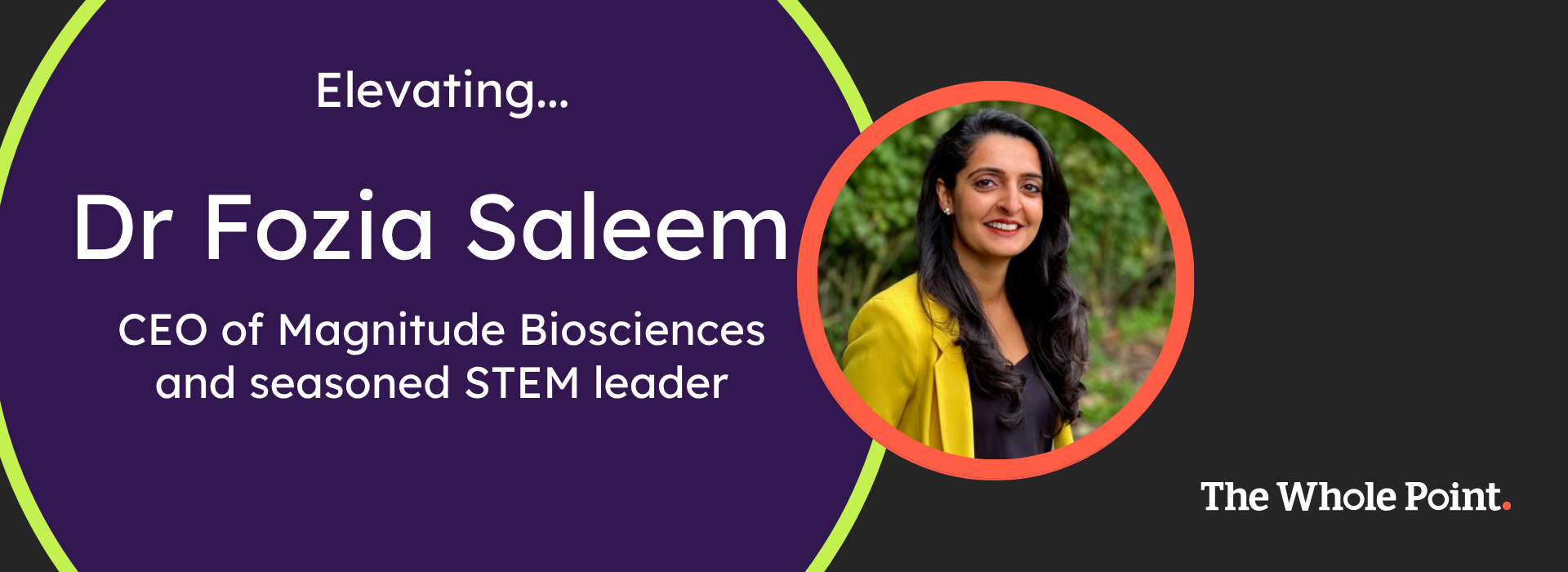
CEO of Magnitude Biosciences and seasoned STEM leader
Welcome back to the Elevate Series from the Newcastle Regional Board of The Whole Point.
For this instalment, we’re joined by Fozia Saleem, CEO of Magnitude Biosciences and a seasoned STEM leader, as she reflects on the leap from corporate life to startup leadership.
With deep roots in the North East and a commitment to building in and for the region, Fozia shares honest insights into navigating the unique funding challenges outside the South. From making investor conversations more efficient to the power of building local networks, her journey is full of lessons for any leader forging their path in underserved ecosystems.
Tell us about your background and journey so far
I’ve spent 20 years in STEM and recently transitioned from a corporate background to a startup. Now, as CEO of Magnitude Biosciences, I’ve learned a lot about finding information and funding, especially in the North East, where networks are less developed.
Originally trained as a scientist, I feel like I’ve come full circle. I prefer SMEs over big corporates, and my diverse experience helps me understand clients’ perspectives, which has been invaluable.
Tell us about your business
I lead Magnitude Biosciences, a North East-based company generating data to support the development of medicines for age-related diseases like dementia, Parkinson’s, and early-onset neurodegeneration. We’re part of the life sciences community, which has a strong base in the region. But as a sector, we still have work to do when it comes to highlighting the amazing science and innovation in the region.
Initiatives like the North East Combined Authority give us a real opportunity to tap into devolution funding, unite as a region, and amplify what we’re achieving here.
There’s huge potential — we just need to shout louder about it.
Tell us about your fundraising journey so far
Our journey began by proving our value before registering the company.
In life sciences, investors want to see clear unmet needs and early client traction. We had to secure our first customer early, which helped set our operational tone.
In the North East, investor access is harder compared to the Golden Triangle. I’m passionate about changing this and influencing policy for fair use of devolution funds.
Some founders relocate to attract investment. But we’re committed to the North East, valuing our local economic impact.
What challenges have you experienced in obtaining funding?
Our first backing came from Northern Accelerator’s ‘Exec in Residence’ programme, giving us runway to shape our business plan while at Durham University. We received our first investment there.
COVID led us to take out a Future Fund loan and move to NETPark, a turning point that accelerated our growth.
Since then, we’ve secured three funding rounds, grown to a team of 22, and built 2.5x revenue off a £1m investment, retaining good equity through grants.
Raising our next £1m round was challenging as a life sciences service provider. Investors suggested loans or self-funding, reshaping my approach to investor conversations.
There’s a significant gap in founder education in the North East; more mentoring and advice would benefit startup founders, especially those from academia.
Tell us about the best non-financial support or advice you’ve received
Building my North East network has been invaluable.
Moving to Newcastle, my connections were elsewhere. By attending events and asking questions, doors opened — including the opportunity leading to this role. Now, I have a network of peers across sectors for advice on HR to finance.
Reaching out has helped me and surprised my co-founders, marking a turning point.
In a corporate setting, I lacked time for informal support networks. In a startup, I’ve been intentional with my time; every action must add value.
The network I’ve built has proven its worth many times. I believe in paying it forward; the right mentors and Non-Executive Directors can change everything.
What excites you most about the future of your business?
Digital innovation. We recently applied for a grant that prompted me to reflect on just how much we’ve already done in this space.
One of our board members once said, “Investors should give you just enough to keep you hungry”. It annoyed me at the time, but that pressure drove our tech team to deliver exceptional work in just six months, and it’s now central to how we operate.
Whether it’s AI, machine learning, or simply automating routine processes, digital tools allow us to free up people to focus on the complex stuff. That blend of tech and talent is becoming our hallmark, and I couldn’t be prouder of that.
What’s one piece of advice you’d have for an entrepreneur just starting out?
Do your homework on the commercial proposition. Is there really a market for what you’re offering, or are you just chasing something shiny?
It might be your passion project, but it needs to solve a real problem for real customers.
Talk to your target market — not just your friends and family — as an echo chamber can be misleading. Getting clear answers early on will either validate your idea, shape it, or send you in a new direction.
It’s far better to pivot early than hit a wall two years in when you’ve already built the wrong team for the job.
How would you improve the ecosystem for women seeking funding?
We need more women in decision-making roles — that’s how we tackle unconscious bias. It won’t happen overnight, but the shift has started.
Personally, I’d love to see anonymised CVs in hiring to eliminate bias at the earliest stage. More importantly, we should move beyond categorising businesses by the gender of their leadership.
I don’t want positive discrimination. I want to succeed on the strength of my ideas, not because I tick a box. The goal is a level playing field, and we’re not there yet.
Who have been your role models?
Marina Trani was the first woman I saw walk into a corporate room full of senior men and command the room.
She did it not by becoming one of them, but by being fully herself. She was unapologetically bold, colourful, passionate, with a strong Italian accent and completely authentic. Watching her in action was a masterclass in leading without dominating. It made me realise I had been toning myself down to fit in.
Marina showed me that authenticity is a strength.
She believed in me before I did and continues to mentor me today. She helped me find my own voice, and that’s made me a better leader.
And finally, who would you like to elevate?
Irim Ali founded and runs her own law firm. She spends time teaching and mentoring female ethnic minority would-be entrepreneurs and was a Labour councillor for Newcastle in her “spare time”.
She’s heavily involved with Ammar Mirza’s Asian Business Connexions efforts, including the Inclusion by Default campaign — a regional initiative aiming to make the North East the UK’s most inclusive region. The campaign works across sectors to embed inclusion as a core principle rather than an afterthought, and Irim is committed to providing support to those who can’t readily access networks or financial/business advice.
Thank you again to The Whole Point Newcastle’s regional board members, Jo Clough – Social Sustainability Director at Lloyds – and Naomi Allen Seales – Investment Manager at Northstar Ventures – who interviewed Fozia for this article.