
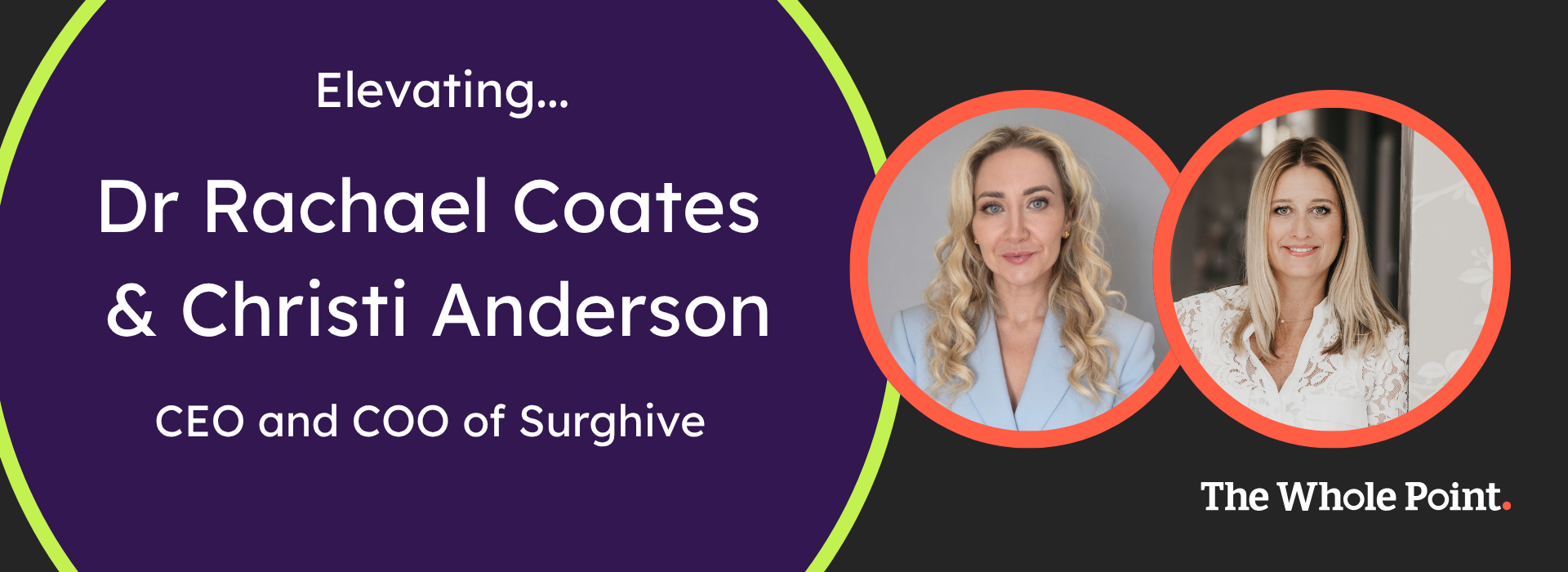
Hello again. We’re back with a new edition of the Elevate Series from the Newcastle Regional Board of The Whole Point. This instalment is a bonus feature as we sit down to speak with Dr Rachael Coates MBA and Christi Anderson – Chief Executive Officer and Chief Operating Officer of Surghive.
Surghive is an award-winning tech business with a VR platform set to transform the world of robotic surgery. Rachael and Christi share their different routes to the tech start-up world, plus the revealing truths and unique opportunities of being a female leader in this space.
Tell us about your background and journey so far
Rachael: I began my career as a robotic colorectal surgeon and quickly became aware of the significant barriers surgeons face when trying to access robotic surgery training.
Alongside my clinical career, I spent more than a decade involved in business and completed an MBA in Artificial Intelligence, combining my interests in healthcare, technology, and innovation. It was through these experiences, and working alongside Surghive co-founder Professor Deena Harji, that the idea for Surghive was born.
We wanted to solve a real-world problem we had experienced firsthand and use technology to improve access to surgical training.
Christi: I grew up on a ranch in Nebraska before studying finance and accounting at university. I started my career with one of the Big Four accounting firms and moved to London on a secondment over 20 years ago.
Throughout my career, I’ve combined roles in finance with entrepreneurial ventures. When I met Rachael and learned about the problem Surghive was trying to solve, I immediately saw the potential. The business combines innovation, healthcare, and global impact, while also showcasing the incredible talent that exists in the North East.
Tell us about your organisation
Rachael: Surghive was created to tackle a major challenge in healthcare: the bottleneck in robotic surgical training. Currently, surgeons often require industry approval and access to specific hardware before they can train — and that creates significant barriers.
Our platform uses mobile technology, virtual reality (VR), and augmented reality (AR) to provide accessible robotic surgery training that can be undertaken more flexibly. Our vision extends beyond robotics training alone. We want to transform surgical education and improve patient safety through innovative immersive learning technologies.
Christi: Coming into the business from outside healthcare, I was struck by how complicated and restrictive the current training pathway is.
Surghive provides a scalable solution to that challenge while creating opportunities for surgeons to access training when and where they need it. The potential impact for both healthcare professionals and patients is enormous.
Tell us about your business model and fundraising journey so far
Christi: One of the strengths of our business is the diversity of our revenue streams. We work with medical device manufacturers to develop and host VR training content, offer subscription-based training directly to surgeons, and partner with organisations such as Royal Colleges that license our content for their own training programmes.
With these routes established, we built a long-term financial model and began developing our investment proposition.
We have received strong interest from investors. But as a pre-revenue business, fundraising remains challenging because many investors want to see evidence of traction before committing.
Rachael: Our journey is unusual because we’re operating in a highly specialised sector with significant upfront development costs. We’re engaging with NHS leaders, Royal Colleges, and global manufacturers on multi-million-pound opportunities, despite still being pre-revenue.
Our challenge is not proving market demand but bridging the gap between product development and securing large-scale commercial contracts.
We now have letters of intent for pilot programmes and we’re in discussions regarding commercial agreements with global manufacturers.
What challenges have you experienced in obtaining funding?
Rachael: Being a pre-revenue business has undoubtedly been one of our biggest hurdles. Many funds claim to support pre-revenue companies, but our experience has often been different in practice. We also operate in a niche market where customer numbers are relatively small, but contract values are very large, making it difficult for traditional investment models to assess us.
As female founders, there’s also an additional challenge around credibility. We often feel we must prove ourselves more than others — although that pressure has ultimately made us stronger and sharper as a business.
We initially focused our fundraising efforts within the North East, but quickly realised many funding criteria did not fit our business. As a result, we’ve looked nationally and internationally, holding discussions with investors in London, the United States, the Gulf region, and beyond.
We’ve found greater appetite for risk and larger ambitions in some of these markets.
Christi: I think one of the biggest differences internationally is risk appetite.
Investors in the United States are often more optimistic about ambitious opportunities and are willing to take bigger bets. As female founders, we also work incredibly hard to balance professional and personal responsibilities, and that’s not always visible to investors.
There remains an expectation that women must continually demonstrate their credibility, even when their experience and expertise speak for themselves.
Tell us about the best non-financial support or piece of advice you have been given
Rachael: One of the most valuable lessons we received early in our fundraising journey was understanding the sheer volume of conversations required to secure investment.
Investors may express interest, but interest does not equal commitment. We learned that it’s essential to maintain a large pipeline and never take our foot off the pedal.
That advice fundamentally changed how we approached fundraising.
Christi: For me, the best advice has been to actively seek help and leverage your network. Warm introductions are far more effective than cold outreach.
Almost everyone is willing to help in some capacity if you ask.
Founders should take the time to review their existing contacts, identify connections, and seek introductions. Those relationships can open doors that would otherwise remain closed.
What are you most excited about for the future of your organisation?
Christi: I’m excited about growing the team and creating opportunities within the Tees Valley. We want to attract great local talent, provide meaningful careers, and build a company that people are proud to work for.
Rachael: I’m excited by the opportunity to create something that doesn’t currently exist. We have ambitions that go beyond simply digitising training. We want to revolutionise surgical education and safety in a way that’s engaging, accessible, and transformative.
The potential impact on patient outcomes is enormous — and the fact that this innovation is being built in the North East makes it even more meaningful.
What’s one piece of advice you would give to a leader just starting out?
Rachael: Be yourself.
If you’re going to make mistakes, make them as yourself, not as the person you think others want you to be.
Authenticity makes leadership easier, more sustainable, and more meaningful. When you stop trying to fit a mould and embrace who you truly are, you build stronger relationships and become a more effective leader.
Christi: Know your strengths and own them, but also understand your weaknesses. Find people who complement your skills and support your development.
No great leader succeeds alone, and the strongest teams are built from diverse strengths working together.
Do you see any barriers for women-led organisations in receiving funding? If so, how would you change the ecosystem to help women secure the funding they need?
Rachael: I believe the challenge goes deeper than the funding ecosystem itself. Real change starts with equality at home, at work, and throughout society.
Women can’t compete on a truly equal footing if they continue to carry a disproportionate share of the mental load and unpaid responsibilities. We also need greater diversity among decision-makers and more women in positions of influence.
Lasting change will come from creating equality in everyday life and ensuring we challenge inequality whenever we see it.
Christi: I completely agree.
Too often, conversations focus on female confidence or imposter syndrome, when the real issue is whether women have the support structures that allow them to fully participate and succeed.
We need to create a society that enables women and men to contribute equally and achieve their full potential.
Who have been your role models?
Christi: I’ve been fortunate throughout my career to work alongside strong female leaders, mentors, and peers.
From the beginning of my career, I saw women succeeding in senior leadership positions, which gave me confidence in what was possible. Today, I continue to draw inspiration from people around me, including my co-founders.
Rachael: My earliest role model was my mum, who instilled in me a belief that I could achieve anything I set my mind to.
Professionally, Professor Deena Harji has been a constant source of inspiration. From becoming the youngest Professor of Surgery in the UK to securing significant research funding and achieving global recognition, she has shown what can be achieved through determination and resilience. Watching her succeed has continually pushed me to aim higher myself.
And finally, who would you like to elevate?
Rachael: I would like to elevate Bethany Ainsley, founder of OptiMe and Nuvo Wellbeing.
Bethany has been an incredible supporter of our journey — opening doors, making introductions, and helping others without seeking recognition. She’s building exciting businesses while quietly supporting entrepreneurs around her, and I believe she’s someone more people should know about.
I’d also highlight Laura-Jayne Priestley, a Teesside entrepreneur with ambitious global aspirations. Having recently launched an innovative swimwear business, she’s at an earlier stage of her journey but is already demonstrating impressive vision and determination. She’s definitely one to watch.
Christi: I would echo Rachael’s suggestions. Both Bethany and Laura-Jayne represent different industries, experiences and stages of growth, but they embody the entrepreneurial spirit and ambition that we need to celebrate and support.
Thank you to The Whole Point Newcastle’s regional board members, Jo Clough – Social Sustainability Director at Lloyds – and Naomi Allen Seales – Investment Manager at Northstar Ventures – for meeting with Rachael and Christi to bring us this interview.