
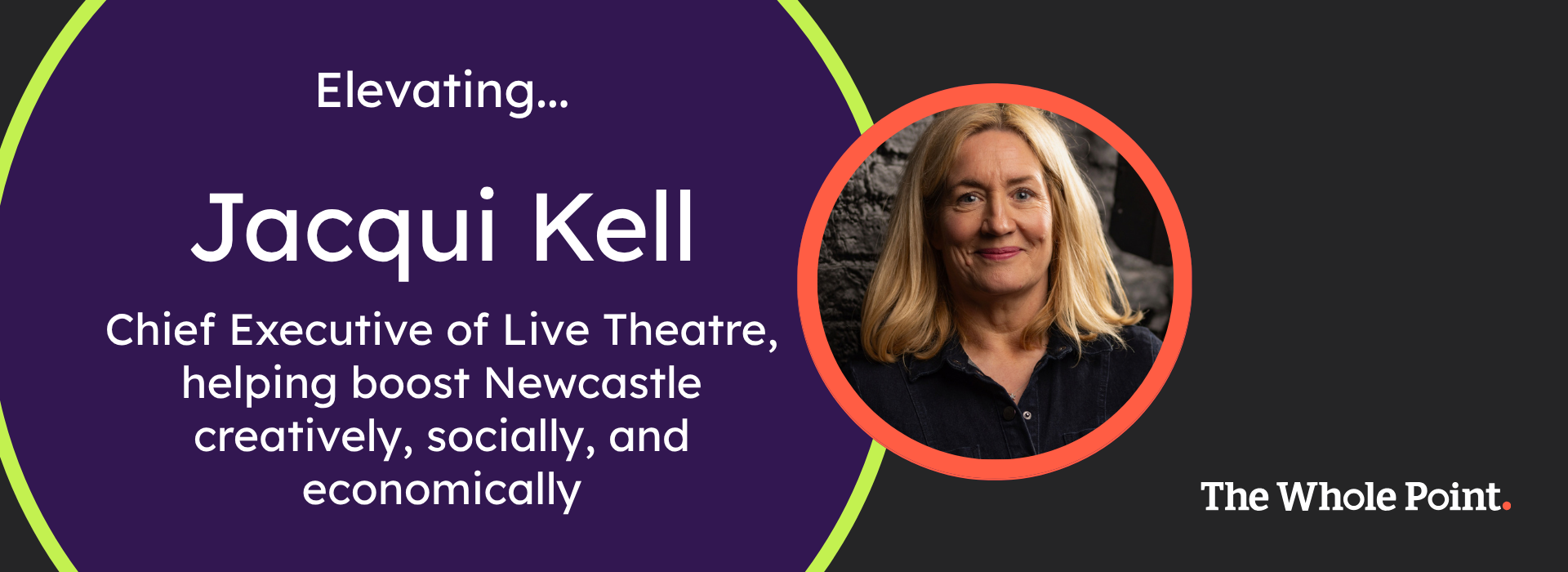
Chief Executive of Live Theatre, helping boost Newcastle creatively, socially, and economically
Welcome to the next instalment of the Elevate Series from the Newcastle Regional Board of The Whole Point.
In this edition, we speak with Jacqui Kell, Chief Executive of Live Theatre in Newcastle. From leaving school at 16 to leading one of the North East’s most important cultural organisations, Jacqui’s journey reflects resilience, authenticity, and a deep commitment to community and place.
Our conversation with Jacqui explores leadership within the cultural sector and highlights the important role organisations like Live Theatre play in nurturing creative talent, strengthening communities, and contributing to the long-term vitality of the region.
Tell us about your background and journey so far
If you’d asked my 16-year-old self where I would end up, I would never have said running a theatre in the centre of Newcastle.
I come from a very working-class background and left school at 16 to join the civil service, which at the time felt like the best possible outcome.
I continued my education while working, and eventually took special leave to study economics at the University of Aberdeen. My interest was never in global economics, but in what was happening in communities: how cities create opportunity, employment, and growth.
That led me into roles across local government and regional development, including Gateshead Council and Newcastle City Council. It was during this time that I began working closely with cultural organisations and saw first-hand the role they play in shaping a city — not just creatively, but economically and socially.
After a period working in Northumberland, I joined Live Theatre as Operations Director at a time when I needed something new. It was a very different environment for me, and I remember initially feeling a sense of imposter syndrome.
But once I stopped trying to know everything and focused on learning, I found my place. Following COVID, I stepped into the Chief Executive role, and several years on, I still feel incredibly proud to be doing it.
Tell us about your organisation
Live Theatre is a new writing theatre based on Newcastle’s Quayside, founded over 50 years ago by a group of unemployed Geordie actors and writers who wanted to create opportunities for themselves when none existed.
That spirit still underpins what we do today.
We produce our own work while supporting writers at every stage of their careers, from early development through to commissioned productions.
Alongside this, we run a strong programme for children and young people, including creative writing in schools and a free youth theatre.
What’s less widely known is that Live Theatre also owns a number of properties around the Quayside. This gives us a unique model: combining cultural activity with commercial income from tenants and creating a small but vibrant creative hub where businesses, artists, and audiences sit side by side.
Tell us about your business model and fundraising journey so far
My experience of funding comes from both sides.
Earlier in my career, I was involved in assessing funding applications, which gave me a clear understanding of what funders are looking for and how decisions are made.
At Live Theatre, we’re fortunate to have funders who trust us and support our work, but the environment is increasingly competitive.
There are many organisations doing valuable work, and securing funding requires constant effort and clarity of purpose.
One of the ongoing challenges is that funding is often project-led. Funders want to support something new, whereas organisations like ours are also trying to sustain work that’s been delivering impact for years. That requires us to continually reframe and refresh how we present our work without losing sight of what really matters.
Through my work with Open Clasp (a feminist theatre company based in the North East), I’ve also seen how funding models can evolve. Comic Relief, for example, takes a much more collaborative approach, working alongside organisations and building trust early. That kind of relationship-driven funding can make a significant difference.
What challenges have you experienced in obtaining funding?
The biggest challenge is the short-term nature of funding and the expectation for constant innovation. It can be difficult to secure support for work that’s already proven and valuable, but not necessarily new.
There’s also a clear regional dimension.
Many funding decisions are still made in London, and there can be lingering perceptions about the North that do not reflect the reality on the ground. That imbalance is improving, but slowly.
Encouragingly, there are initiatives beginning to address this, including efforts to reconnect successful individuals with the North East and encourage reinvestment into the region.
Tell us about the best non-financial support or piece of advice you have been given
The most important advice I received when stepping into senior leadership was simply to be myself.
There can be a tendency, particularly for women, to feel that leadership requires adopting a different style or persona. In reality, authenticity is one of the most powerful tools you have.
You do not need to change who you are to lead effectively.
Closely linked to that is managing imposter syndrome. It’s easy to feel like you don’t belong in certain rooms. But if you’re there, it’s because someone has recognised your credibility.
The challenge is not to shrink in those moments, but to own your place.
What’s the thing that you are most excited about in the future for your organisation?
We have a really exciting period ahead.
A key moment for us is the stage adaptation of Our Friends in the North, produced in partnership with Newcastle Theatre Royal. It’s a project with both creative and commercial potential, and it reflects a broader focus on building more sustainable income streams.
We’re also investing in our estate, including the development of music and podcast recording studios, which will open up new opportunities for collaboration and income generation.
But more than anything, what excites me is the energy of the building itself — seeing it full of writers, actors, young people, and audiences. That sense of activity and purpose is what everything else is built around.
What one piece of advice would you have for a leader just starting out?
Stay true to your values.
Strategies, funding models, and external pressures will all change, but your values should remain constant. They provide a foundation for decision-making, particularly in more challenging moments.
For me, fairness and integrity have always been central. When things become difficult, those are the principles I come back to.
Do you see any barriers for women-led organisations in receiving funding?
In the arts, gender representation is relatively strong, particularly at grassroots level. However, challenges still exist as organisations grow and scale, and representation at senior levels is not always consistent.
There’s also a broader issue around who’s making funding decisions. Increasing diversity at that level would help create a more balanced and inclusive ecosystem.
Alongside this, it’s important to recognise the value of networks. Leadership can be isolating, but support is often there if you seek it out. Mentors, peers, and advisors can make a significant difference.
Who have been your role models?
My role models are not necessarily high-profile figures. More often, they’re people I have observed over time — they’re individuals who show consistency, resilience, and a strong work ethic.
I’m particularly drawn to people who bring positivity and energy into the organisations they are part of. I often think in terms of ‘radiators and drains’. It’s important to surround yourself with people who lift others up, rather than pull them down.
Someone whose journey I admire from afar is Dame Irene Lucas-Hays, owner and chair of Hays Travel. Her career path demonstrates that leadership can come from many different starting points and that progression is possible with the right mindset and determination.
And finally, who would you like to elevate?
What I feel most strongly about is elevating younger working-class women who may not have access to the same networks or opportunities. At Live Theatre, we work with young people from communities that are underrepresented in leadership roles, helping them build confidence, skills, and ambition.
If we can help create pathways for those individuals to see themselves as future leaders, that is where the real long-term impact lies.
Thank you to The Whole Point Newcastle’s regional board members, Jo Clough – Social Sustainability Director at Lloyds – and Naomi Allen Seales – Investment Manager at Northstar Ventures – for creating this article.