
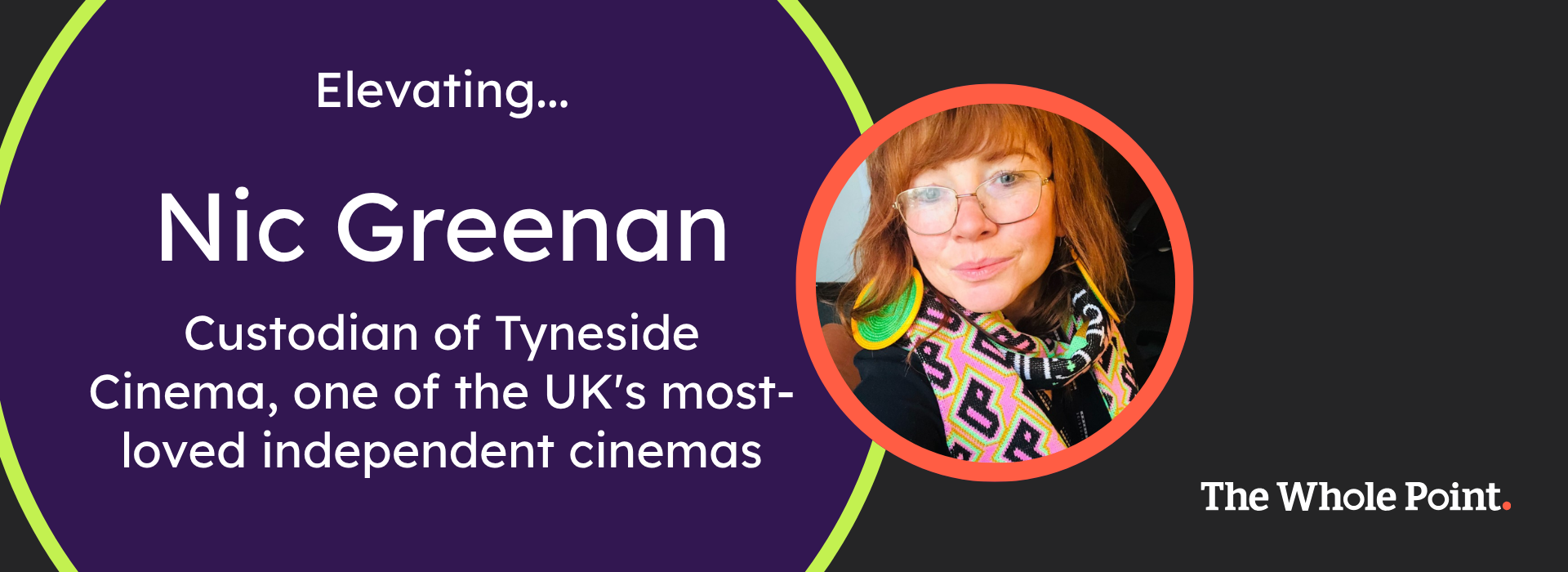
Custodian of Tyneside Cinema, one of the UK’s most-loved independent cinemas
Welcome to the next instalment of the Elevate Series from the Newcastle Regional Board of The Whole Point. In this edition, we speak with Nic Greenan — Custodian of Tyneside Cinema, one of the UK’s most-loved independent cinemas.
From growing up on a council estate in Leeds to stewarding a much-loved cultural institution in the North East, Nic’s journey has been shaped by access, kindness, and a deep sense of responsibility to place.
This conversation is an interesting deviation from our usual venture-backed stories, packed with valuable insights about leadership and values.
Tell us about your background and journey so far
I grew up on a large council estate in Seacroft, on the outskirts of Leeds, without exposure to the cultural or business worlds and with no clear sense of where I might end up. As a teenager, an outreach programme at the West Yorkshire Playhouse gave me my first experience of theatre and opened my eyes to possibilities beyond what I knew.
I struggled in mainstream education and left school with very few formal qualifications, but there was always an underlying sense that I wanted to be useful and to have some agency, even if I didn’t yet know what that meant.
Later, as a young mum and then a single parent, wanting my daughter to have more options motivated me to return to education as a mature student, eventually graduating in Arts Management from the University of Leeds. Assuming no one would give me a job, I set up my own arts management company — a pivotal step that built my confidence, expanded my horizons, and ultimately led me to Tyneside Cinema.
Tell us about your organisation
Tyneside Cinema is far more than a cinema. Film sits at the heart of what we do, but we’re also a cultural venue, a hospitality space, an events organiser, and a place of learning and engagement, holding deep personal meaning for many people.
When I joined, I deliberately changed my title from CEO to Custodian — because my role is not just to run an organisation efficiently but to look after something that feels owned by the community.
The idea of custodianship reflects my belief that leadership is about stewardship rather than ownership, and about holding responsibility for something that existed long before you and should endure long after.
My role is to respect Tyneside’s heritage while ensuring its long-term future.
Tell us about your fundraising journey so far
We operate as a charity limited by guarantee, supported by a trading company that runs our hospitality and events, while the cinema itself relies on a box office model with very tight margins due to distributor fees. Because of this, diversification has been essential. And we’ve worked hard to grow our events and hospitality offer so the organisation isn’t solely reliant on ticket sales.
For me, sustainability is not just a financial model but a mindset, where everyone understands how the organisation survives and feels responsible for its long-term health.
My ambition is for Tyneside to be financially stable, with grants and donations providing additional support rather than being the core source of income.
What challenges have you experienced in obtaining funding?
One of my biggest concerns around funding is mission drift.
Spending too much time chasing money can lead organisations to reshape themselves around funders’ priorities rather than their purpose.
That’s why we don’t have a dedicated fundraising manager, as I want sustainability to be a shared responsibility across the organisation.
When fundraising sits with one person, it can create a disconnect between income generation and delivery. Shared ownership strengthens resilience and long-term organisational health.
Tell us about the best non-financial support or advice you’ve received
One of the most impactful pieces of advice I’ve received came from the CEO of Greggs, who told me to “Kill them with kindness” when dealing with difficult people issues.
It reminded me that kindness and care should be present in every room you walk into, even when you have to say things people don’t want to hear.
You can be honest and firm without losing compassion, and that balance is a powerful leadership tool.
What excites you most about the future of your organisation?
I’m incredibly excited about launching our Talent Unit, which will support the next generation of working-class talent in Newcastle and the wider North East, backed by three years of funding to develop the programme properly.
Alongside this, I’m focused on raising £5 million for capital redevelopment and delivering Tyneside’s ninetieth anniversary in 2027. It feels like a pivotal moment to invest in both people and place while securing the organisation’s future.
What advice would you give to a leader just starting out?
- Build a team of experts around you and don’t be afraid of having people who are better than you — that’s a strength, not a weakness.
- Support good people on their journey rather than fearing their departure, because relationships endure beyond roles.
- Be clear about what needs control, but trust your team, accept mistakes, and create the space for people to do their best work.
Do you see any barriers for women-led organisations in receiving funding, and how would you change the ecosystem?
I haven’t personally experienced significant barriers in grant funding, but I have found that success is often built on relationships, trust, and track record, and I tend to apply only where I feel confident we will be successful.
I always rely on a strong team of experts around me, many of whom have been men, and while that may play a role, it’s something I haven’t fully unpicked.
Who have been your role models?
My role models have changed over time.
Jude Kelly, who was artistic director at the West Yorkshire Playhouse, was a real inspiration to me.
My Nana was incredibly caring and generous, even though she had very little herself. She taught me that generosity is about how you choose to show up for others.
Kersten England, who was CEO of Bradford Council, showed me how to navigate difficult moments with grace and strength.
If I can be a little bit like any of them, I will be happy.
And finally, who would you like to elevate?
I’d like to elevate Lesley Douglas. She’s originally from the North East and previously worked at the BBC before returning to the region to set up a production company (Lonesome Pine) in Byker.
She’s been brave in choosing to build here and committed to bringing high-quality creative work back to the region. I think she’s doing something really important.
Thank you again to The Whole Point Newcastle’s regional board members, Jo Clough – Social Sustainability Director at Lloyds – and Naomi Allen Seales – Investment Manager at Northstar Ventures – who interviewed Nic for this article.